
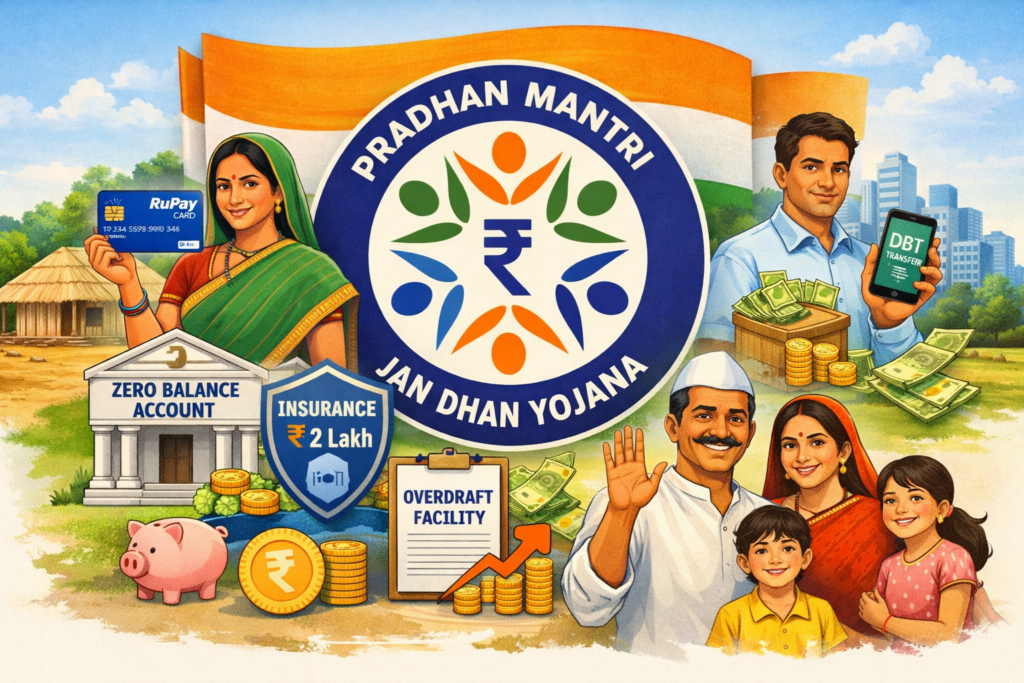
In a country as vast and diverse as India, access to banking was once considered a privilege rather than a basic necessity. Millions of families, especially in rural and semi-urban areas, lived without a bank account. This changed dramatically with the launch of Pradhan Mantri Jan Dhan Yojana (PMJDY), a revolutionary step toward universal banking access. Today, this scheme stands as one of the world’s largest financial inclusion programs, redefining how India manages welfare distribution and economic empowerment.
If you are looking to understand the impact, benefits, and relevance of Pradhan Mantri Jan Dhan Yojana, this detailed guide covers everything in a simple and practical way.
What is Pradhan Mantri Jan Dhan Yojana?
Pradhan Mantri Jan Dhan Yojana is a flagship government initiative launched on 28 August 2014 with the aim of providing affordable access to financial services such as banking, savings, deposits, credit, insurance, and pension to every household in India.
The primary objective of this scheme is to ensure that every citizen has access to at least one basic savings bank account, eliminating financial exclusion. By connecting the unbanked population to the formal banking system, PMJDY has strengthened India’s economic framework at the grassroots level.
Why Financial Inclusion Matters
Before PMJDY, millions of Indians relied on informal money lenders who charged extremely high interest rates. Lack of access to formal banking meant:
- No secure savings option
- No access to affordable credit
- No insurance protection
- No direct benefit transfers from government schemes
Through Pradhan Mantri Jan Dhan Yojana, the government created a pathway for economic empowerment by integrating the poor into the mainstream financial system.
Key Features of Pradhan Mantri Jan Dhan Yojana
The success of Pradhan Mantri Jan Dhan Yojana lies in its well-structured benefits. Let’s explore its major features:
1. Zero Balance Account
One of the biggest advantages of PMJDY is that individuals can open a bank account with zero balance. This removes the financial barrier that previously discouraged low-income families from accessing banking services.
2. RuPay Debit Card
Account holders receive a RuPay debit card, enabling digital transactions and ATM withdrawals. This promotes digital banking and reduces dependency on cash transactions.
3. Accidental Insurance Cover
Each account holder is eligible for accidental insurance coverage (subject to conditions). This provides financial security in case of unforeseen incidents.
4. Overdraft Facility
After satisfactory operation of the account for six months, beneficiaries can access an overdraft facility. This helps families manage short-term financial emergencies.
5. Direct Benefit Transfer (DBT)
Government subsidies and welfare benefits are directly transferred into Jan Dhan accounts. This eliminates middlemen and ensures transparency.
Objectives of Pradhan Mantri Jan Dhan Yojana
The scheme is not just about opening bank accounts. Its broader goals include:
- Promoting financial literacy
- Encouraging savings habits
- Providing access to micro-credit
- Offering insurance and pension products
- Strengthening digital financial infrastructure
Through Pradhan Mantri Jan Dhan Yojana, the government aims to create an inclusive financial ecosystem that supports long-term economic stability.
Impact of Pradhan Mantri Jan Dhan Yojana on Indian Economy
Since its launch, PMJDY has achieved remarkable milestones. Crores of bank accounts have been opened across rural and urban India. The scheme has significantly increased:
- Bank penetration in rural areas
- Women’s participation in banking
- Digital payment adoption
- Direct benefit transfers efficiency
By integrating marginalized communities into the formal economy, Pradhan Mantri Jan Dhan Yojana has strengthened India’s banking network and reduced financial inequality.
How to Open a Jan Dhan Account
Opening an account under Pradhan Mantri Jan Dhan Yojana is simple and accessible. Here’s the general process:
- Visit your nearest bank branch or business correspondent.
- Fill out the PMJDY account opening form.
- Provide basic KYC documents (Aadhaar, Voter ID, or other valid ID).
- Submit passport-size photographs (if required).
Even individuals without full documentation can open a small account with simplified KYC norms.
Role of Jan Dhan in Digital India
The Digital India movement gained momentum because of PMJDY. When the COVID-19 pandemic hit, the government transferred financial assistance directly into Jan Dhan accounts. This demonstrated how Pradhan Mantri Jan Dhan Yojana plays a critical role in crisis management and welfare distribution.
By linking Jan Dhan accounts with Aadhaar and mobile numbers (the JAM Trinity Jan Dhan, Aadhaar, Mobile), India created a powerful digital financial ecosystem.
Women Empowerment Through PMJDY
One of the most impactful outcomes of Pradhan Mantri Jan Dhan Yojana is women’s financial empowerment. A significant portion of Jan Dhan accounts are held by women, especially in rural areas.
Having personal bank accounts allows women to:
- Control household savings
- Receive government benefits directly
- Gain financial independence
- Build credit history
This has contributed to social transformation at the grassroots level.
Challenges Faced by the Scheme
Despite its success, PMJDY has faced certain challenges:
- Dormant accounts with no transactions
- Limited financial literacy in rural areas
- Need for better awareness campaigns
However, continuous government efforts are addressing these issues by promoting financial education and digital awareness.
Benefits of Pradhan Mantri Jan Dhan Yojana
Let’s summarize the core advantages:
- Universal access to banking
- Zero balance savings account
- Insurance protection
- Overdraft facility
- Transparent subsidy transfer
- Encouragement of digital payments
These benefits make Pradhan Mantri Jan Dhan Yojana one of the most impactful social welfare initiatives in India.
Future of Pradhan Mantri Jan Dhan Yojana
The future of PMJDY looks promising. As India moves toward a cashless and digitally empowered economy, Jan Dhan accounts will continue to serve as the foundation of financial inclusion.
With increasing digital adoption, improved financial literacy, and enhanced banking services, Pradhan Mantri Jan Dhan Yojana is expected to play a key role in achieving long-term economic development goals.
Pradhan Mantri Jan Dhan Yojana is not just a government scheme—it is a movement toward economic empowerment. By providing universal access to banking services, it has changed the financial landscape of India.
From rural farmers to urban laborers, from women entrepreneurs to small vendors, millions have benefited from this initiative. The scheme has strengthened India’s economic structure by ensuring transparency, security, and inclusion.
If India aims to become a truly developed economy, initiatives like Pradhan Mantri Jan Dhan Yojana will continue to serve as the backbone of inclusive growth.
Financial inclusion is no longer a dream it is a reality shaped by Jan Dhan.
Frequently Asked Questions (FAQs)
1. What is Pradhan Mantri Jan Dhan Yojana?
Pradhan Mantri Jan Dhan Yojana (PMJDY) is a government scheme launched to provide universal access to banking facilities such as savings accounts, deposits, insurance, pension, and credit services, especially for economically weaker sections.
2. Who is eligible for Pradhan Mantri Jan Dhan Yojana?
Any Indian citizen above 10 years of age who does not have a bank account is eligible to open an account under Pradhan Mantri Jan Dhan Yojana, including rural residents, women, laborers, and low-income families.
3. Can a Jan Dhan account be opened with zero balance?
Yes, a Jan Dhan account can be opened with zero balance. However, to avail certain benefits like insurance and overdraft facilities, the account must remain active and follow scheme guidelines.
4. What documents are required to open a Jan Dhan account?
To open an account under Pradhan Mantri Jan Dhan Yojana, basic KYC documents such as Aadhaar Card, Voter ID, PAN Card, or any government-approved identity proof are required. Accounts can also be opened with simplified KYC.
5. What insurance benefits are available under PMJDY?
Account holders are eligible for accidental insurance coverage and life insurance benefits, subject to conditions. This makes Pradhan Mantri Jan Dhan Yojana an important social security initiative.
6. What is the overdraft facility in Jan Dhan Yojana?
The overdraft facility allows eligible account holders to withdraw money beyond their account balance after satisfactory account operation. This helps beneficiaries meet short-term financial needs.
7. Is RuPay Debit Card provided with Jan Dhan account?
Yes, every account holder under Pradhan Mantri Jan Dhan Yojana receives a RuPay Debit Card, enabling ATM withdrawals, online payments, and digital transactions across India.
8. How does Jan Dhan Yojana help in Direct Benefit Transfer (DBT)?
Pradhan Mantri Jan Dhan Yojana enables Direct Benefit Transfer, ensuring that government subsidies, pensions, and welfare payments are credited directly into beneficiaries’ bank accounts without intermediaries.
9. Can Jan Dhan accounts receive government schemes benefits?
Yes, Jan Dhan accounts are linked with multiple government schemes like pensions, subsidies, and financial assistance programs, making them a key part of India’s welfare delivery system.
10. Why is Pradhan Mantri Jan Dhan Yojana important for financial inclusion?
Pradhan Mantri Jan Dhan Yojana promotes financial inclusion by bringing unbanked citizens into the formal banking system, encouraging savings, digital payments, and economic empowerment across India.